
Updated 11 November 2026 · ADIN.AI
This matters most for brands that run many markets with different agencies. Without a shared gate, the regional report adds up numbers that were never comparable.
- Check before you consolidate. If consolidation comes first, errors are found after the money is committed.
- Write the limits into a system. A spend cap that lives in an email is not a limit.
- Compare with your own history. Last year's results are the best benchmark you have.
- Automate the checks, keep people on approvals. Every exception needs a named approver and a record.
Why can't people check cross-market plans by hand?
Because the number of things to check grows faster than any team can. Take a brand in 12 markets, on 6 channels, with 4 objectives. That is 288 budget lines in one plan, each with its own limit, benchmark and brand rule. Once the campaign is live, budgets move every week, and every move needs the same checks again.
People handle this the only way they can: they sample. They review the biggest markets and the largest lines, and trust the rest. That is where the errors hide.
- Names drift. One market's "awareness" is another market's "upper funnel video". No one can read 288 lines closely enough to catch every mismatch.
- Limits get missed. The spend cap for a smaller market is easy to overlook when the review is focused on the big ones.
- History gets skipped. Comparing every line with last year's results is the first check to go when time is short.
This is work AI does well: the same checks, on every line, every time a plan or a budget changes. People keep the part that needs judgement: the exceptions and the approvals.
The seven checks
| # | Check | Compared against | Who signs off |
|---|---|---|---|
| 1 | Taxonomy | The shared naming for objectives, channels and formats | Marketing operations |
| 2 | Market budget limit | Minimum and maximum spend per market | Regional lead |
| 3 | Channel allocation | Minimum and maximum share per channel, and spend commitments | Head of media |
| 4 | Brand rules | Brand safety, compliance and regulation for that market | Brand or legal |
| 5 | Benchmarks | The brand's own past results for the same objective | Head of media |
| 6 | Measurement plan | One agreed method per objective, set before launch | Analytics lead |
| 7 | Named approver | A person, a date and a threshold | Budget owner |
Which platforms compare proposed channel allocations against market budget limits before approval?
Look for three capabilities, whatever the vendor:
- Limits stored in the system. Minimum and maximum spend per market, channel and campaign.
- A comparison step. The proposed split is shown next to the limits and next to past results, before anyone approves.
- An approval record. Who approved, when, and what changed.
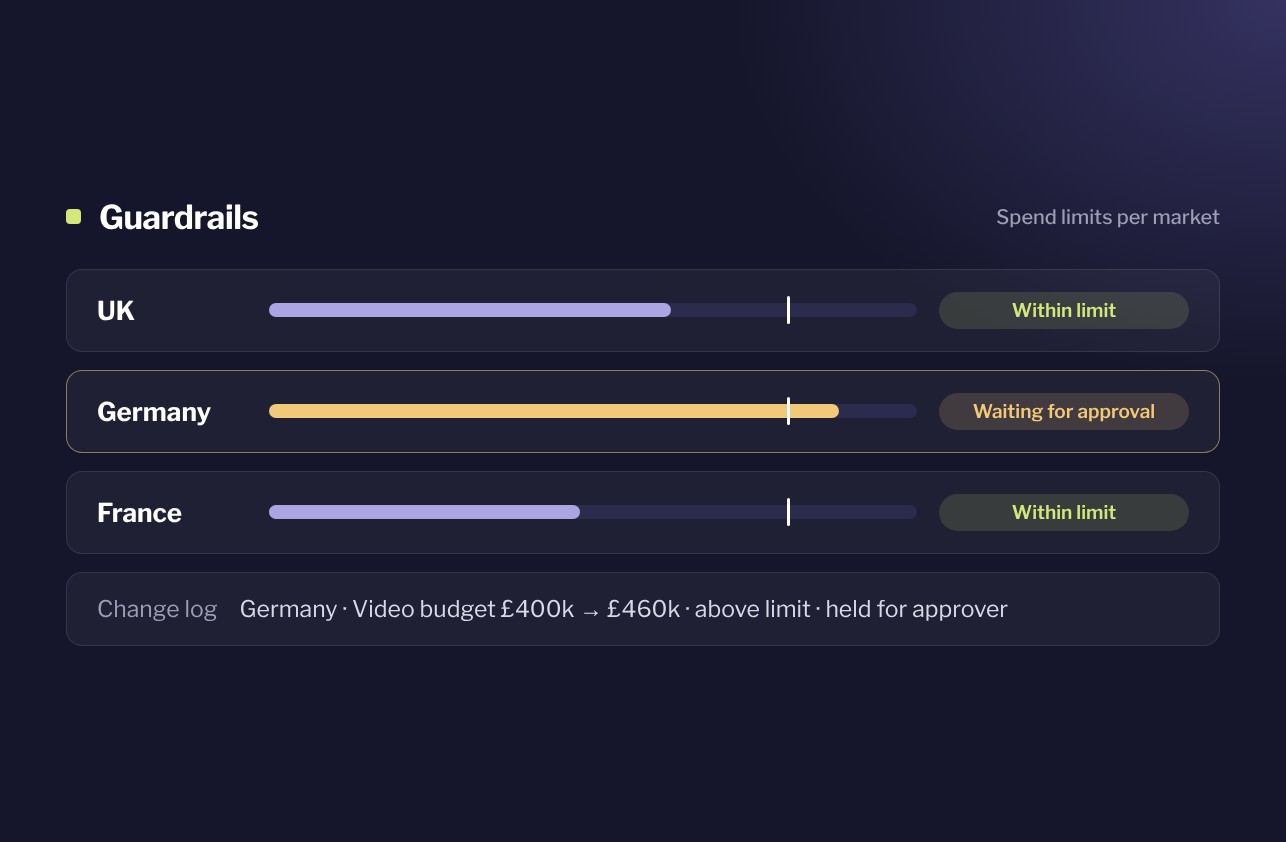
Workflow tools such as Mediaocean and Camphouse manage plans and approvals across teams. ADIN.AI keeps the brand's rules, spend commitments and past decisions in Brand Memory, checks proposed budget moves against them, and holds changes above a threshold for a named approver. Every change is logged with the old value, the new value and the reason. Because Media Intelligence, Creative Intelligence and Consumer Intelligence sit in one platform, the reviewer also sees how the planned creative is scoring and what is shifting in that market, in the same place as the plan.
Why should the check sit outside the agency?
The plan comes from the agency. The check should not. When the same party writes a plan and checks it, mistakes are easy to miss and hard to raise.
Many agencies still plan with their own small tools or with third-party software, and each agency uses something different. An independent technology platform applies the same rules to every agency in every market. Its business is the software, not hours or media, so it has no reason to favour one plan over another. That is what makes the check something the brand can trust.

How do enterprise media plan systems validate agency submissions before consolidating cross-market reports?
In practice it is a gate with four steps:
- The agency submits the plan in the shared format.
- The system checks it against the stored limits and rules.
- Exceptions go to the right approver with the reason attached.
- Only approved plans flow into the consolidated cross-market report.
The order matters. If consolidation happens first, errors are found after the money is committed.
What does the industry say about AI and approvals?
- The IAB released its AI Transparency and Disclosure Framework in January 2026 and updated it in August 2026. It covers when AI use in ads should be disclosed to people. It is not about media decisions, but the direction is the same: be open about where AI is used.
- BCG's 2026 survey of 300 CMOs found that 96% say AI is changing marketing, and 8% run autonomous multi-agent campaigns. Most teams are still in the stage where people approve.
- Basis's 2026 Advertising Agency Report found that 29.1% of agencies use AI for media planning.
So for most enterprises in 2026, the realistic setup is this: automate the checks, keep people on the approvals.
A short checklist to copy
- One naming standard, shared with every agency
- Spend limits per market and per channel, written into a system
- Each plan compared with the brand's own past results
- One measurement method per objective, agreed before launch
- An approval threshold and a named approver
- A log of every change with a reason
Frequently asked questions
What is a media plan validation gate?
A fixed set of checks every agency plan has to pass before it is approved and added to the consolidated report. Plans that fail go back with the reason.
Who should own plan validation?
Marketing operations usually owns the checks. The budget owner in each market or region owns the approval.
What is a market budget limit?
A minimum and maximum spend for one market, agreed in advance and stored in a system, so a plan above or below it is flagged before launch.
Can AI approve media plans on its own?
It can run the checks. For most enterprises the approval of exceptions stays with a named person, and the change is logged.
How does ADIN.AI help?
ADIN.AI stores the brand's rules and spend limits, checks proposed budget moves against them, holds changes above a threshold for a named approver, and logs every change. Media, creative and consumer intelligence are in the same platform, so a plan is reviewed with its creative and its market in view.
Sources: IAB, AI Transparency and Disclosure Framework (January 2026, updated August 2026). BCG, Making the agentic marketing transformation a reality (June 2026). Basis, 2026 Advertising Agency Report. Vendor descriptions are based on public information as of November 2026.