Updated 27 October 2026 · ADIN.AI
This guide walks through the new workflow step by step and shows which decisions stay with people. At the end you'll find a 10-question checklist to run on any AI planner before you trust it with real budget.
- Before: the plan is built in spreadsheets, locked at launch and reviewed weeks after the money is spent.
- After: a first draft comes from your history and a brief in minutes, gets tested in scenarios, then keeps adjusting while campaigns run.
- Your team keeps the brief, the guardrails and the final call. The model does the arithmetic and the watching.
- The plan only gets smarter if every decision is stored. Most teams skip this part.
Why does the traditional media plan break at enterprise scale?
A large brand rarely plans from a blank page. It plans from last year's plan, the agency's benchmarks and each platform's own recommendations. Every platform grades its own homework, so nobody sees the full mix in one place.
Then the plan gets locked at launch. Money stays where it was put while prices, audiences and creative fatigue change week by week. The review comes after the budget is gone.
And the learning leaves with people. Why did CTV get 20% last spring? Which market overspent on search? The answers sit in old decks and in the heads of people who may have moved on.
Marketers are already changing this. AI's share of marketing activities rose from 13.1% in 2024 to 24.2% in 2026 (The CMO Survey, Duke University, 2026). Planning is an obvious place for that shift. It's the most arithmetic-heavy part of the job.
What does an AI media planning workflow look like?
1. Write the brief
Goal, budget, markets, main KPI and the rules that can't be broken. This stays human. A model can't know that the brand team promised a retailer a minimum spend, or that one market is off limits this quarter, unless someone tells it.
2. Draft the plan from your own history
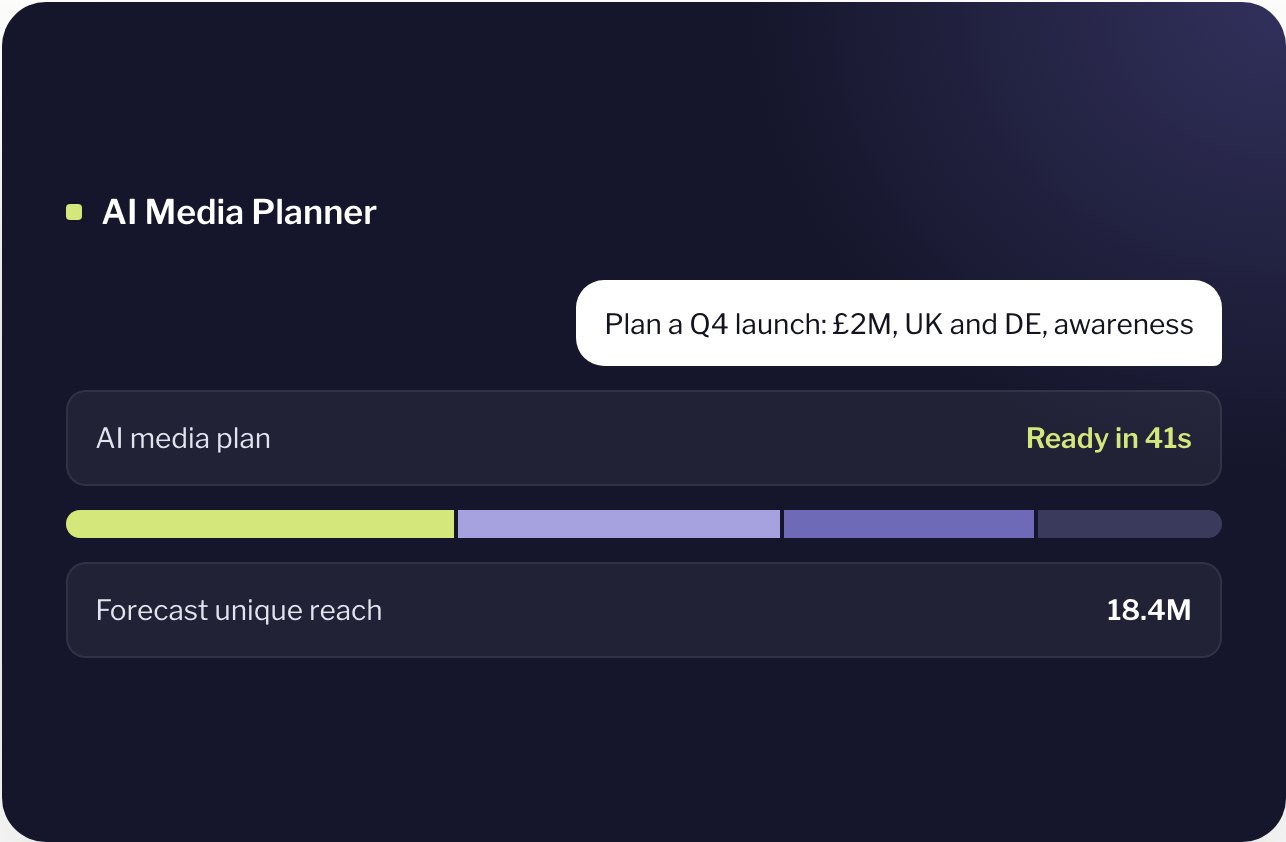
The planner reads past performance across your channels and builds a cross-channel plan from the brief, a prompt or a few filters. In ADIN.AI, the AI Media Planner draws on up to 10 years of past performance data and builds a full-funnel plan in minutes instead of days.
The important word is your. A plan built on your own results beats one built on platform averages, because your audience, creative and prices aren't average.
3. Test scenarios before you spend
What happens to reach if 20% moves to CTV? What if TikTok is capped? A good planner shows expected results for each option side by side, so the debate moves from opinions to trade-offs. You pick the scenario. The model doesn't.
4. Check the creative before launch
Media and creative fail together. Predictive pre-testing scores assets before any spend, so weak creative doesn't get blamed on the channel mix.
5. Optimise in flight, inside your guardrails
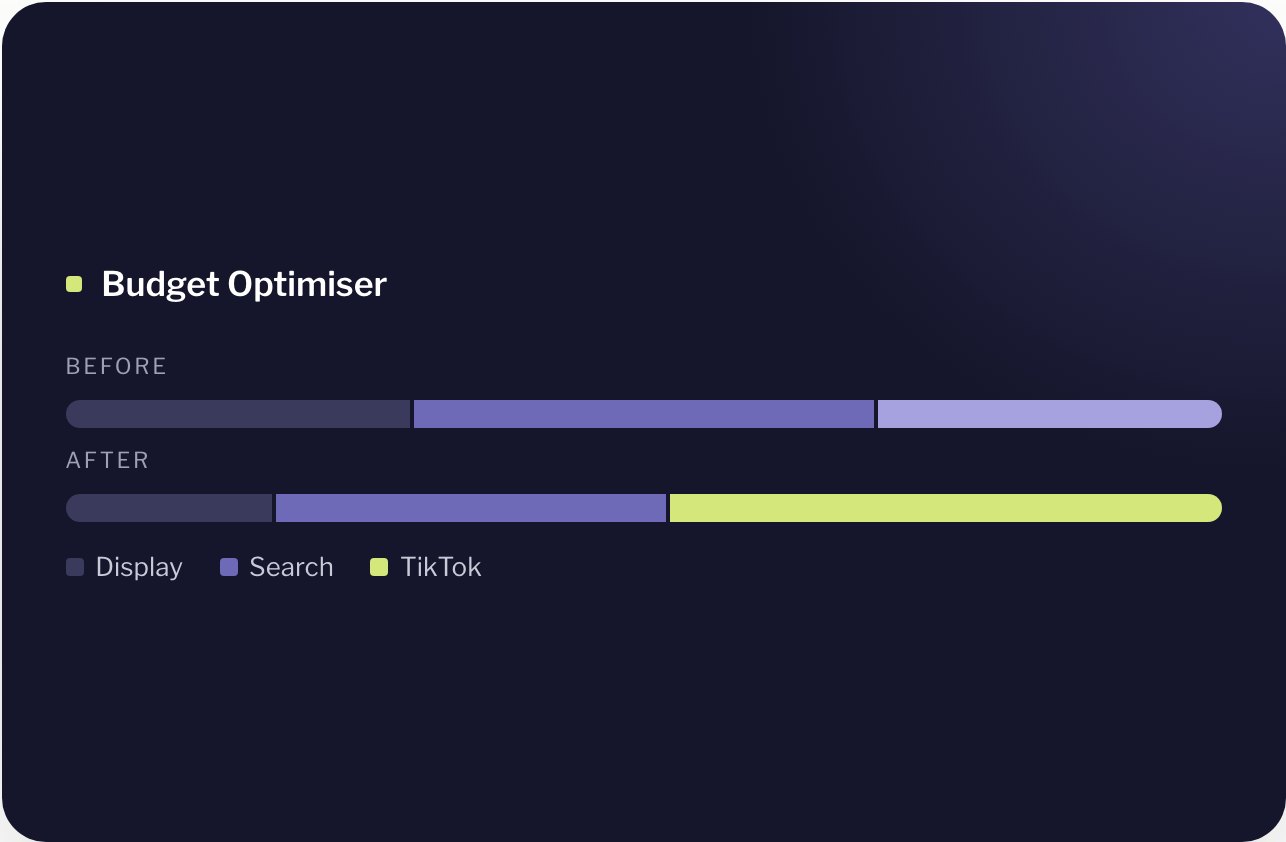
This is the step that changes the most. Instead of waiting for a monthly review, budget moves across channels and campaigns toward what is working, within rules you set: spend caps, channel minimums, pacing, brand safety and approval steps.
Your team chooses the mode. Approve each change, or let the platform apply changes inside the limits. Vodafone Home Internet used ADIN.AI across Meta, Google Ads, TikTok and DV360 and cut cost per thousand impressions and cost per view by 41.3% (company-reported result).
6. Write every decision down
Every change gets logged: what moved, when and why. The outcome feeds the next plan. We call this Brand Memory, the layer that holds your brand rules, past decisions and feedback so the next recommendation fits your brand instead of a generic one.
Without this step you have a faster spreadsheet. With it, the plan gets better every quarter.
Which parts of planning should stay with people?
| Stays with your team | Moves to the model |
|---|---|
| Business goal and KPI | First draft of the channel mix |
| Budget and hard rules | Forecasts for each scenario |
| Brand and market judgement | Reading hundreds of signals in flight |
| Approving changes (or setting the limits for auto-apply) | Moving budget daily within those limits |
| Deciding what to test next | Logging every change and its result |
A simple test: if a decision needs context that lives outside the data (a retailer deal, a launch date, a sensitive market), it stays human. If it needs speed and arithmetic across many channels, the model is better at it.
How do planners stay in control of an AI ad platform?
Control comes from design, not from trust. Look for five things:
- Hard limits the model can't cross: spend caps, channel minimums, pacing rules.
- Approval modes you can set per brand, market or campaign.
- A change log that shows every move with its reason.
- Brand rules stored once and applied to every recommendation.
- Plain-language answers. Ask why budget moved and get a straight reply, not a chart to decode.
If a vendor can't show all five in a demo, the "AI" probably means automation without accountability.
What should you measure in the first 90 days?
- Time from brief to approved plan.
- Share of budget moved during the campaign, not only at planning time.
- Share of recommendations your team accepted, and why the rest were rejected.
- Cost per outcome against the same period or a holdout market.
- Number of decisions logged with a result attached.
Agree on the baseline before the pilot starts. Otherwise every result is a debate.
Where does ADIN.AI fit?
ADIN.AI is one AI platform for enterprise marketing teams. It sits across the channels you already buy in (Google, Meta, TikTok, DV360 and other DSPs, connected TV) and turns their data into plans, scores and actions. It doesn't replace your DSP or your agency's buying. It gives the brand one view of the whole mix and a memory of every decision.
It is trusted by 50+ brands in 20+ countries. L'Oréal started with one pilot and expanded to 20+ brands.
When is an AI planner not worth it?
If you run one or two channels with a small monthly budget, a platform's native tools are probably enough. The value shows up when budgets are spread across many channels, markets or brands, and when the same mistakes keep coming back each quarter.
The 10-question checklist for any AI media planner
Run these in the demo, on your own data if possible.
- Does the first plan come from our history, or from industry averages?
- Can we compare at least three scenarios before spend?
- Which channels does it read side by side, including walled gardens?
- Can it move budget during the campaign, and how often?
- What hard limits can we set, and can the model ever cross them?
- Can we choose between approve-each-change and auto-apply?
- Is every change logged with a reason we can read?
- Where are our brand rules stored, and who can edit them?
- Does it learn from rejected recommendations?
- Who owns the data and the decision history if we leave?
If you get clear answers to all ten, you're looking at a planner. If not, you're looking at a dashboard with a forecast button.
Frequently asked questions
Will AI replace media planners?
No. It removes the manual work: building drafts, reconciling platform reports, watching pacing. Planners spend more time on the brief, the guardrails and the judgement calls.
How long does it take to build a plan with AI?
A first cross-channel draft takes minutes once your channels are connected. Agreeing the brief and the rules still takes the time it should.
Can the AI change campaigns without approval?
Only if you allow it. In ADIN.AI your team approves each change or sets limits for automatic changes, and every change is logged.
Does an AI planner replace our DSP or agency?
No. Buying still happens in DSPs and walled gardens. The planner gives the brand one view across them and decides where budget should go.
What data does an AI planner need?
Access to your ad accounts and, ideally, analytics and sales data. The more history it reads, the more the plan reflects your brand instead of averages.
Sources: The CMO Survey, Duke University, 2026. Customer results are company-reported; results vary by brand and campaign.