Updated 27 October 2026 · ADIN.AI
Below are seven findings from the radar, with data as of 26 October 2026, what we'd do with each one, and how the radar arrives at a number in the first place. Every chart on this page is taken from Market Radar as members see it.
- About two in five (39%) of the consumer shifts we track now run through AI. Finance is highest, at 53%.
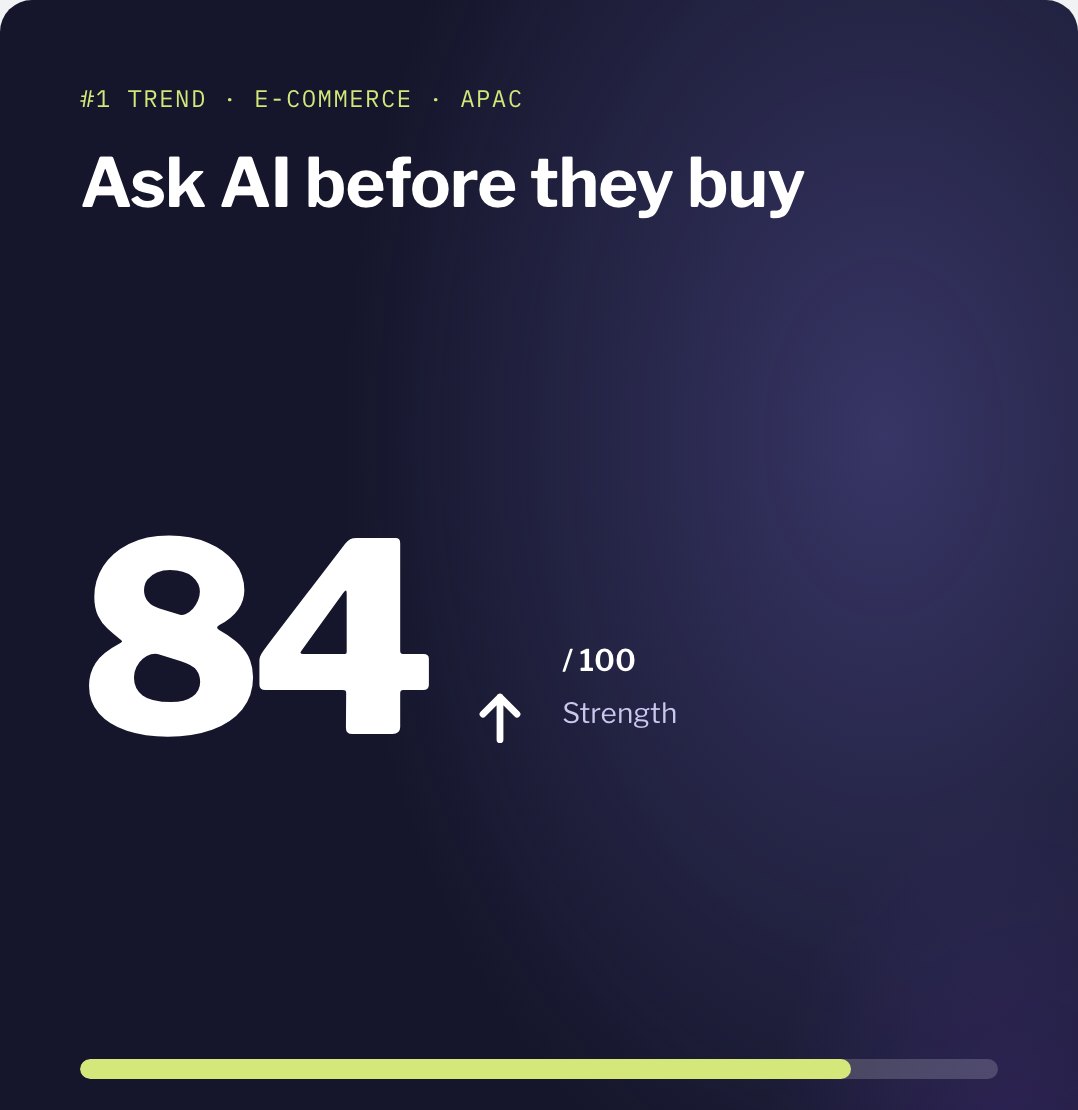
- Asking AI before buying is the strongest single trend on the radar: 84 out of 100 in e-commerce in Asia-Pacific, where 64% already do it.
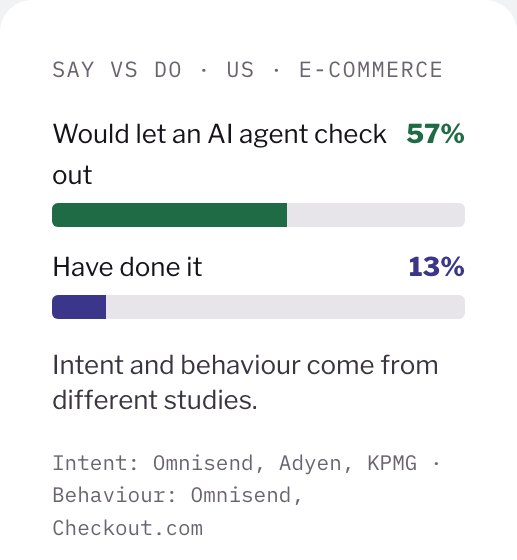
- Intent is far ahead of behaviour. 57% of US shoppers say they'd let an AI agent check out for them. 13% have.
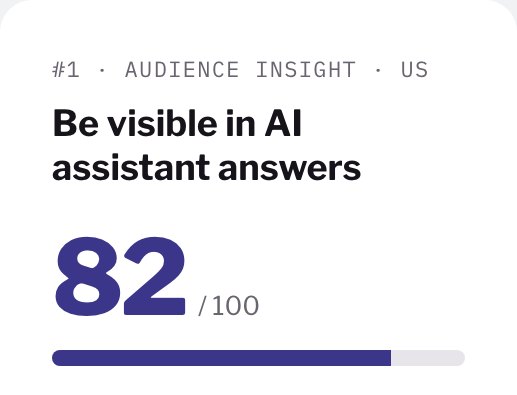
- Marketers feel the shift. Showing up in AI assistant answers is the top audience-insight need for US brand marketers, at 82 out of 100.
What is consumer intelligence?
Consumer intelligence means tracking what people do and why, from research, search and behavioural data, so marketing decisions start from the customer and not from last year's plan. The hard part right now is AI. Research on AI and consumers is everywhere, and most of it doesn't agree. One survey says most shoppers use AI, the next says a fifth do, and both can be right because they asked different people different questions. A brand team doesn't have the time to read forty reports and decide which ones to trust.
Market Radar does that reading. More than 50 agents scan sources every week: published studies, search data and site traffic. Every figure keeps a link to where it came from. The radar now holds 810,000+ data points from studies in 155 countries and boils each trend down to one Strength score out of 100.
It covers seven sectors (beauty, fashion, food and beverage, telco, finance, e-commerce and consumer electronics) in the US, EMEA, Latin America and Asia-Pacific.
How are consumers using AI in 2026?
How much of consumer behavior now runs through AI?
About two in five. Of all the consumer shifts we track, 39% have AI behind them. Either people do the thing with AI, or AI has changed how they do something they already did.
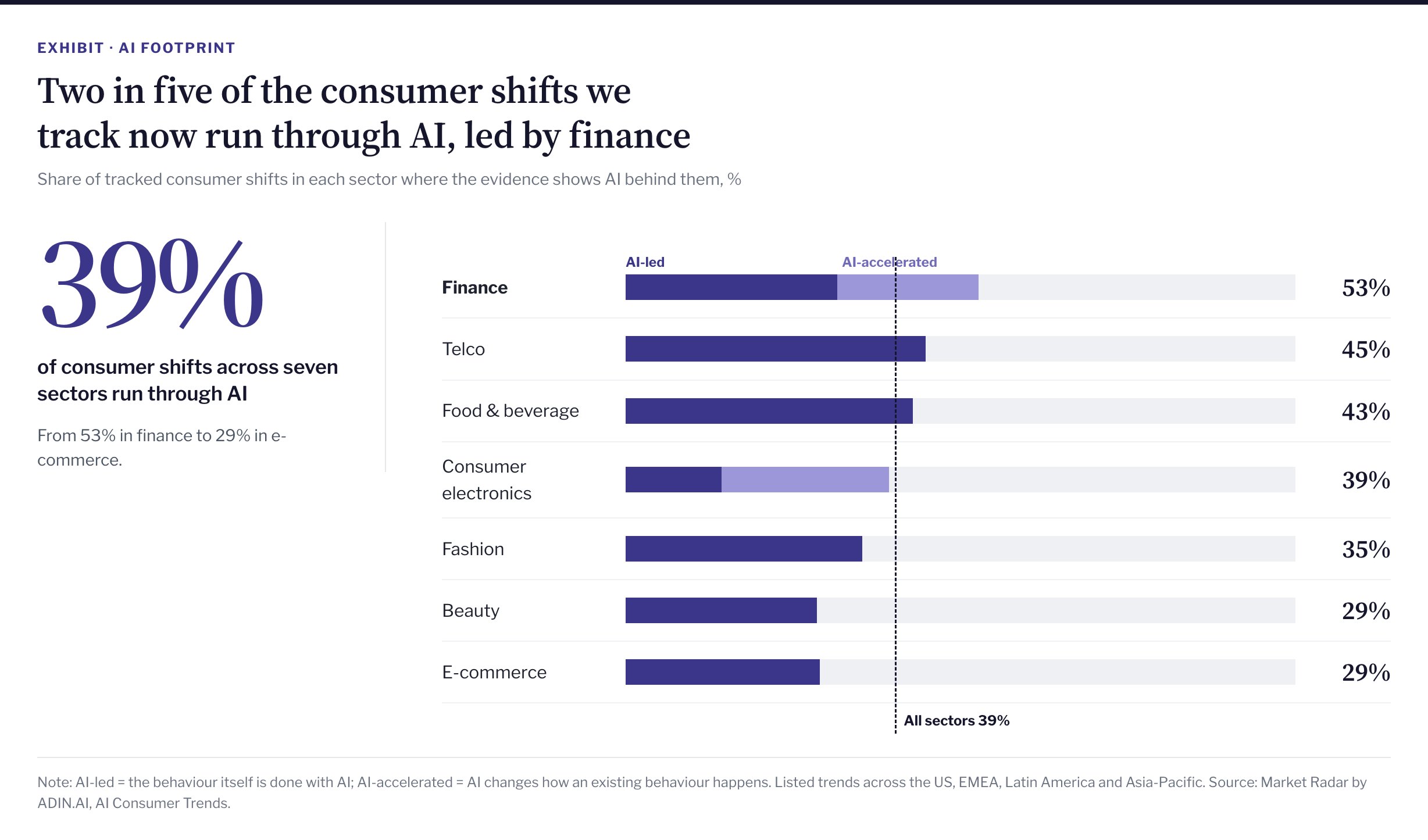
E-commerce near the bottom surprised us at first. Most of what's changing in online shopping, such as value hunting, faster delivery and flexible payment, has nothing to do with AI. The AI trends that do exist in e-commerce, though, are the strongest on the whole radar. Which brings us to the next one.
How many people use AI to shop?
More than most people think, and the share is growing. In e-commerce in Asia-Pacific, asking AI before buying scores 84 out of 100, the strongest trend on the whole radar. 64% of shoppers there already do it, and the trend is rising. The same behaviour leads fashion in Latin America, at 79.
What we'd do: make prices, stock and reviews readable to AI assistants, not only to search engines. If an assistant can't quote your price, it will quote someone else's.
Will shoppers let AI agents buy for them?
This is what people now call agentic commerce: an AI agent that doesn't only recommend a product but pays for it. 57% of US consumers say they would let an AI agent complete a purchase for them. 13% have actually done it. The two numbers come from different studies (intent from Omnisend, Adyen and KPMG; behaviour from Omnisend and Checkout.com), so read the gap as a direction, not a precise measurement.
Planning a budget around the 57% would be a mistake. Ignoring it would be one too. This is where checkout is heading, just more slowly than the headlines suggest.
Do people use AI as a beauty advisor?
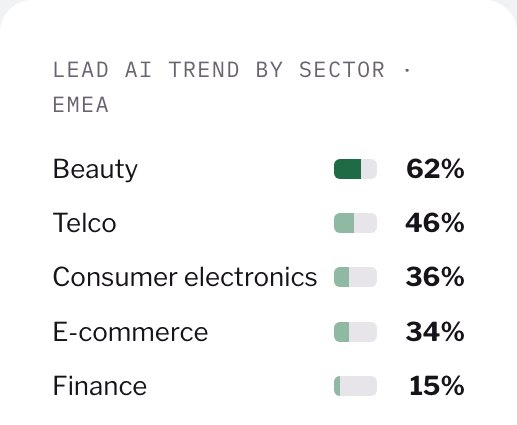
Yes, and more than in any other sector we can compare. 62% of consumers in EMEA already turn to AI as a beauty advisor. Compare the leading AI habit in other sectors in the region: telco at 46%, consumer electronics at 36%, e-commerce at 34% and finance at 15%.
Finance is the odd one. It has the largest AI footprint of any sector, yet its leading AI habit in EMEA reaches only 15% of people. AI is touching many small money decisions, but none of them is mainstream yet.
Are telco customers loyal, or just staying put?
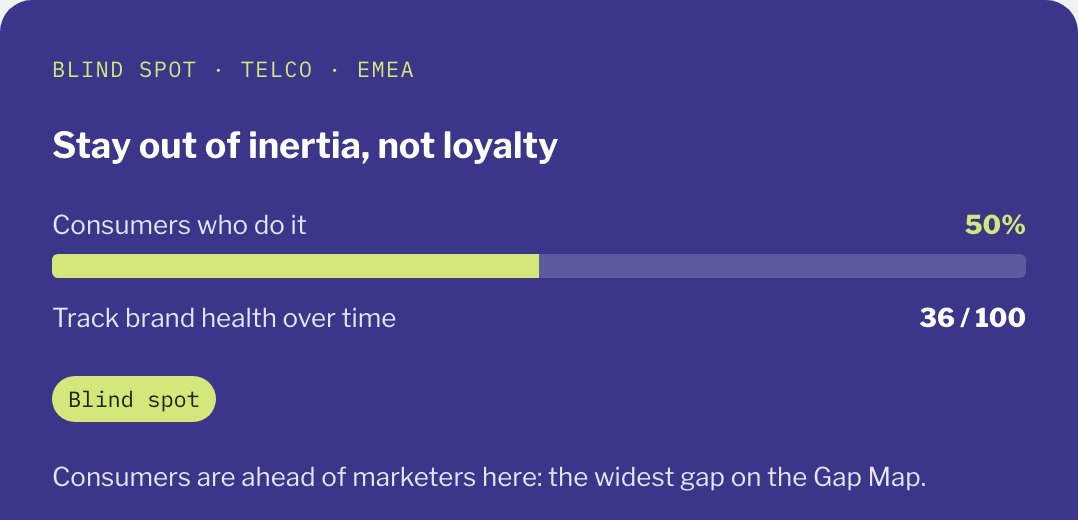
Many are just staying put. 50% of telco customers in EMEA stay with their provider out of inertia rather than loyalty. The matching need on the marketer side, tracking brand health over time, scores only 36 out of 100. It's the widest gap on our Gap Map, which puts consumer trends next to what marketers ask for.
If half your base stays because switching feels like work, an assistant that compares tariffs in seconds is a real threat. Brand health is worth measuring before that happens, not after.
Do brands need to show up in AI search answers?
Marketers think so. For US brand marketers, the top audience-insight need is to be visible in AI assistant answers. It scores 82 out of 100, adoption is at 42%, and its share of related search grew 99% in three months (Google Keyword Planner). In a separate IAB study, 48% of US buyers said they measure, or plan to measure, brand visibility and citations inside AI tools.
Are marketing teams ready for AI?
Mostly not yet. 70% of CMOs say their internal marketing processes aren't mature enough to implement and scale AI (Gartner, 2026 CMO Spend Survey, n=401). We'd put that number next to all the others on this page. Consumers are changing faster than most marketing departments can.
How does Market Radar turn research into one score?
Each trend gets three readings. Size is the share of people who already do it, taken from studies with a named sample. Direction shows whether it's rising, flat or falling, from search and site-traffic data. Confidence says how much evidence sits behind the reading. Together they make the trend's Strength, from 0 to 100.
Two other measures sit on top. The AI footprint shows how much of a whole sector runs through AI. The Gap Map shows where consumers have moved and marketers haven't. The full method is on the How we measure page.
The radar has a marketer side too. Marketing Trends scores what brand-side marketers need next in growth and media, creative and audience insight, by region.
Who uses a consumer intelligence platform?
Brand, insight and strategy teams who need to know what's changing before it shows up in their own numbers, and agencies preparing a pitch or a planning cycle. The eight key findings are open to read. Membership opens every sector and region, the evidence behind each score and the Gap Map.
How does Market Radar fit with the rest of ADIN.AI?
Market Radar is the consumer intelligence part of the platform. It looks outward, at the market. Media Intelligence and Creative Intelligence look inward, at your own campaigns and creative. The radar tells you a habit is spreading; the other two show whether your plan and your ads are keeping up with it.
Frequently asked questions
What is consumer intelligence?
Tracking what consumers do and why, from research, search and behavioural data, so that marketing decisions start from the customer and not from last year's plan. In ADIN.AI, this is Market Radar.
What is agentic commerce?
Shopping where an AI agent completes the purchase for the customer, not only recommends a product. 57% of US consumers say they would allow it; 13% have done it so far.
How many people use AI to shop?
It depends on the market and the sector. In e-commerce in Asia-Pacific, 64% of shoppers already ask AI before they buy. In EMEA, 62% of consumers use AI as a beauty advisor.
Where does Market Radar's data come from?
Published studies with a named sample, search data and site-traffic data, scanned every week by more than 50 agents. Every figure links to its source.
Which sectors and regions does it cover?
Seven sectors (beauty, fashion, food and beverage, telco, finance, e-commerce and consumer electronics) in the US, EMEA, Latin America and Asia-Pacific.
How often is it updated?
Sources are scanned every week. Each finding shows the date of the data behind it.
Does Market Radar use my brand's own data?
No. It reads market data: research, search and traffic. Your own campaign data stays in the ADIN.AI platform.
Sources: Market Radar by ADIN.AI, data as of 26 October 2026. Third-party figures: Omnisend, Adyen, KPMG and Checkout.com (AI agent checkout); IAB, 2026 Outlook Study: September Update (n=211); Gartner, 2026 CMO Spend Survey (n=401); search share from Google Keyword Planner.