Updated 12 October 2026 · ADIN.AI
- Cross-channel campaign optimisation is difficult for large advertisers because data is fragmented across platforms, each platform defines and attributes results differently, and many markets, brands and agencies add their own layers, so no single view of performance exists by default.
- Multichannel reporting becomes trustworthy when it rests on a common naming taxonomy, normalised metric definitions, a clear split between platform-reported and independent measurement, and a fixed reporting cadence tied to decisions.
- AI-based ad platforms change enterprise media planning by turning a spreadsheet process that takes days into plans built in minutes, with forecasts, scenario comparisons and continuous optimisation, while people keep approval over each change.
- When choosing a cross-channel platform, large advertisers should check channel coverage, metric normalisation, independent measurement such as marketing mix modeling, creative and media measured together, governance controls and a complete change log.
- ADIN.AI approaches the problem as one marketing intelligence platform that reads media and creative across every channel, then plans, optimises and applies the change, with the team approving each change or letting ADIN.AI apply it.
Why is cross-channel campaign optimisation hard for large advertisers?
Cross-channel optimisation is hard for large advertisers because the information needed to compare channels is split across systems that were never designed to agree with each other. The bigger the organisation, the more platforms, markets, brands and partners there are, and each one adds another version of the truth.
The difficulty is structural, not a skills gap. The main causes are consistent across industries.
Fragmented data
Search, social, video, programmatic, connected TV, digital out-of-home and retail media each live in their own interface. Spend, delivery and results sit in separate accounts, often exported by hand into spreadsheets. By the time the numbers are combined, the campaign has moved on.
Different metrics and attribution per platform
Platforms use different definitions for similar ideas. A view, an engagement or a conversion can be counted with different thresholds and attribution windows. Each platform also tends to credit itself for outcomes it touched, so adding up platform-reported conversions usually counts the same customer more than once.
Walled gardens
The largest platforms keep user-level data inside their own environments. Advertisers can see aggregated results but cannot easily join them with data from other channels. This limits independent verification and makes de-duplication across channels difficult.
Many markets, brands and agencies
An enterprise may run dozens of brands across many countries, with different agencies, currencies, languages and naming habits. The same campaign type can be labelled five different ways. Without a shared structure, a global view requires manual reconciliation every time someone asks a question.
Creative and media measured separately
Media teams usually look at reach, cost and conversion, while creative teams look at attention, recall and brand fit. When the two are measured in different tools, nobody can tell whether a result came from the placement or the message, and budget decisions ignore half the picture.
Slow reporting cycles
Monthly or quarterly reports describe what already happened. When optimisation depends on a reporting cycle that slow, money keeps flowing to underperforming lines for weeks before anyone acts.
How do you build multichannel ad reporting that people trust?
Multichannel reporting earns trust when everyone agrees on what is being counted, where each number comes from and how often it is reviewed. The work is mostly about definitions and structure; the dashboard is the last step, not the first.
- Agree a common taxonomy. Define one naming convention for campaigns, markets, brands, objectives, funnel stages and creative. Apply it across every platform and agency, and make it a condition of launch rather than a clean-up task afterwards.
- Normalise metrics. Write down a single definition for each core metric (cost per mille, cost per acquisition, return on ad spend, video completion rate, and so on) and map each platform's native metric to it. Where platforms cannot be made equivalent, say so in the report rather than hiding the gap.
- Separate platform-reported and independent measurement. Platform numbers are useful for optimising inside a channel. Decisions about how much to give each channel need a view that does not depend on any one platform grading its own work.
- Add marketing mix modeling. Marketing mix modeling (MMM) uses historical data to estimate the incremental contribution of each channel to business outcomes such as sales or revenue. It answers the question platform attribution cannot: what would have happened without this spend.
- Set a cadence tied to decisions. Daily or real-time views suit in-flight optimisation. Weekly views suit budget moves between channels. Quarterly views suit mix and planning decisions. Each report should state which decision it supports.
- Show recommended actions next to the numbers. A report that ends with a list of metrics leaves the hard part to the reader. Reports that surface what should change, and why, are far more likely to be used.
A practical test: if two people in different markets read the same report and reach different conclusions about which channel performed best, the taxonomy or the metric definitions are not yet shared.
Should you trust platform-reported results or independent measurement?
Use both, for different questions. Platform-reported results are the fastest signal for optimising within a channel, while independent measurement such as marketing mix modeling is the better basis for deciding how budget is split between channels.
| Question | Best source | Why |
|---|---|---|
| Which ad set or creative is working inside one channel? | Platform-reported data | Fast, granular and close to the auction. |
| Which channel deserves more budget next quarter? | Marketing mix modeling and cross-channel scoring | Estimates incremental contribution without relying on each platform's self-attribution. |
| Did the campaign change brand perception? | Brand lift and ad recall studies | Measures effects that clicks and conversions do not capture. |
| Was the creative or the placement responsible? | Creative effectiveness data read alongside media data | Separates the message from the media buy. |
The common mistake is to sum platform-reported conversions and treat the total as fact. Because each platform credits itself, that total is usually inflated, and channels that are good at claiming credit look better than channels that do the real work earlier in the funnel.
How do AI-based ad platforms affect enterprise media planning workflows?
AI-based ad platforms shift enterprise media planning from a slow, spreadsheet-based process into a continuous loop of planning, forecasting, optimisation and review. Planning that once took days can be done in minutes, and the plan keeps adjusting during the campaign instead of being fixed at launch.
From spreadsheets to plans in minutes
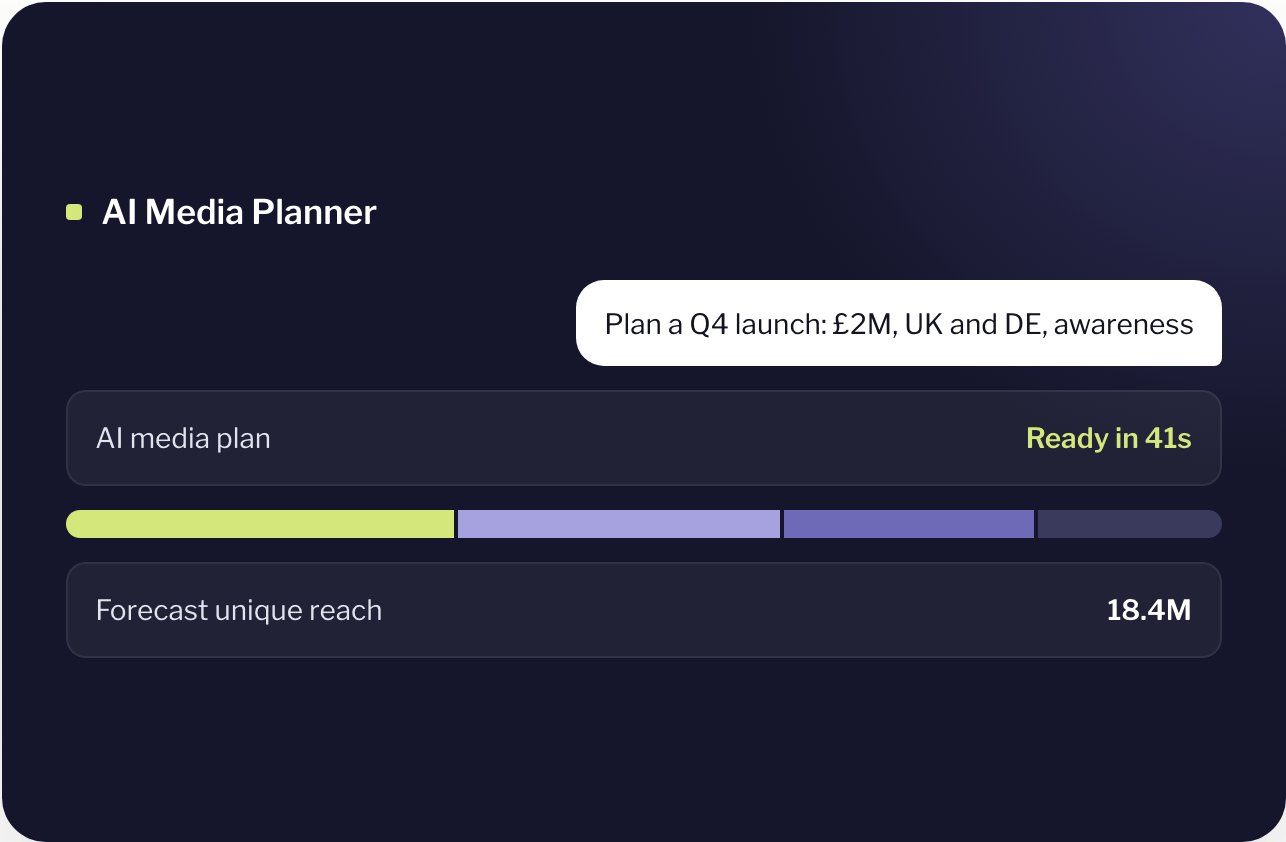
In a traditional workflow, planners collect past results from each channel, rebuild them in a spreadsheet, apply assumptions and negotiate a split. An AI media planner draws on historical performance across channels and builds a full-funnel plan from a set of filters or a written prompt, such as a budget, markets and an objective.
Forecasting
Instead of a single expected outcome, the planner projects likely results such as reach, cost and conversions for each channel mix. Forecasts are only as good as the history behind them, which is why clean, consistently labelled data matters so much.
Scenario planning
Teams can compare alternatives side by side: a larger share for video, a shift towards one market, a lower cost ceiling. This turns budget conversations into a comparison of scenarios with explicit trade-offs, rather than a debate based on habit.
Continuous optimisation
Once live, the system reads performance signals and recommends changes: moving budget between channels, refreshing creative that shows fatigue, adjusting frequency caps. A published example: during Vodafone Home Internet's Back-to-School 2025 campaign, AI suggestions produced 126 optimisation recommendations across Meta, Google Ads, TikTok and DV360 (see the case).
Human approval and an audit log
The role of the planner changes rather than disappears. People set objectives, rules and limits, then approve changes or allow the system to apply them within those limits. Every change should be recorded with what changed, when, why and who approved it, so decisions can be reviewed later.
What does not change: someone still owns the objective, the brand rules and the final call. AI removes manual assembly work; it does not remove accountability.
What should large advertisers look for in a cross-channel ad platform?
Look for a platform that solves the structural problems, not one that only adds another dashboard. The checklist below covers the capabilities that matter most at enterprise scale.
| Capability | What to ask | Why it matters |
|---|---|---|
| Channel coverage | Does it connect search, social, video, programmatic, CTV, digital out-of-home and your measurement tools? | Gaps in coverage recreate the fragmentation you are trying to remove. |
| Metric normalisation | How are platform metrics mapped to common definitions? | Without it, cross-channel comparison is not fair. |
| Independent measurement | Is marketing mix modeling or another incrementality method included? | Budget allocation should not depend on platforms grading themselves. |
| Creative and media together | Can it score creative effectiveness alongside media effectiveness? | Shows whether results come from the message or the placement. |
| Planning and action | Can it build plans, forecast scenarios and apply changes, or only report? | Insight without action leaves the manual work in place. |
| Governance | Can teams approve changes, set limits and see a full change log? | Large budgets need control and an audit trail. |
| Brand context | Does it hold brand rules, compliance requirements and past decisions? | Generic AI produces generic recommendations. |
| Multi-brand and multi-market structure | Can it roll up from campaign to brand to company across markets and currencies? | Enterprises need one view without losing local detail. |
| Data separation and security | Is each customer's data held in isolated pipelines? | Advertising data is commercially sensitive. |
It also helps to ask for published client results with named brands and case pages, and to check whether claimed gains are described as typical or as potential upside.
What are the most common mistakes in cross-channel programmes?
The most common mistakes are treating reporting as the goal, trusting summed platform attribution, and automating before rules and approvals are defined.
- Building a dashboard before agreeing definitions. A combined view of inconsistent numbers looks authoritative but misleads.
- Optimising each channel in isolation. Every channel can hit its own target while the overall mix underperforms.
- Ignoring creative. Shifting budget away from a channel when the real problem was a tired creative wastes the channel's potential.
- Automating without guardrails. Automation should operate inside written limits, with approval steps for larger changes.
- Keeping knowledge in people's heads. When the person who knew why a rule exists leaves, the rule is lost. Brand rules and past decisions should be written into the system the team uses.
How does ADIN.AI approach cross-channel advertising?
ADIN.AI is the All in One Marketing Intelligence Platform for enterprise brands. It brings media intelligence and creative intelligence into one brain: it reads a brand's media and creative across every channel, then plans, optimises and applies the change, while the brand's team stays in control.
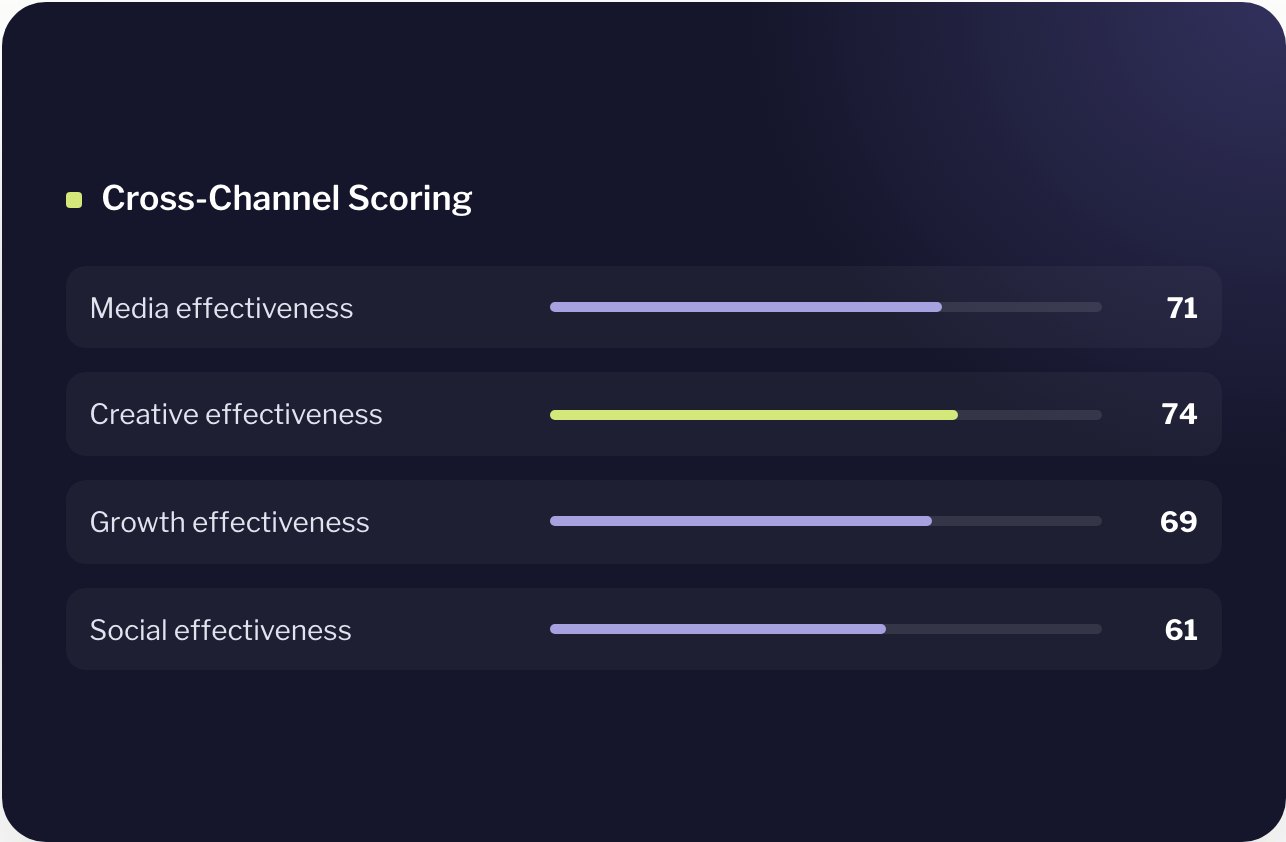
The platform works in three steps. Connect brings every channel and tool into one model, including Google, Meta, TikTok, LinkedIn, programmatic platforms such as DV360, connected TV, digital out-of-home and digital radio, plus measurement tools. See turns the data into clear scores for media, creative, growth and social effectiveness at company, brand and campaign level. Act plans, optimises and makes the change; the team approves each change or lets ADIN.AI apply it, and every change is logged.
The eight modules map to the problems in this guide:
- Holistic Dashboard and Smart Custom Reports for one view of every campaign, channel and market, with reports that surface recommended actions.
- Cross-Channel Scoring for media and creative effectiveness as simple scores that can be compared across channels.
- Marketing Mix Modeling for which channel drives what across the whole mix, independent of platform self-attribution.
- AI Media Planner for cross-channel plans in minutes, from filters or prompts, drawing on historical performance.
- Smart Optimization, Audience Targeting and Budget Optimiser for in-flight changes within limits the advertiser sets.
Brand Memory keeps the brand's context: its own ad data, its rules (brand golden rules, compliance and regulation, brand DNA, audiences, spend commitments) and its people's past decisions. Teams can also ask questions about ads, plans or performance in plain language with Talk to your data. Since April 2026, DAIVID creative effectiveness data flows into ADIN.AI.
ADIN.AI is built for large brands that run marketing across many channels, markets and brands, and the agencies that work with them. It is not designed for small businesses or single-channel advertisers. Published results include Maybelline New York's 71% lower cost per ad recall (case) and Vodafone Home Internet's 41.3% lower CPM and CPV (case). ADIN.AI reports up to 5x ROAS improvement as potential upside; results vary by client and campaign.
Frequently asked questions
What makes cross-channel campaign optimisation platforms difficult for large advertisers?
Large advertisers have data spread across many platforms that define and attribute results differently, plus walled gardens that limit data joining, many markets, brands and agencies with their own naming, and creative measured separately from media. A platform has to normalise all of this before it can compare channels fairly, which is why setup, taxonomy and governance matter as much as the software.
How do AI-based ad platforms affect enterprise media planning workflows?
They replace manual spreadsheet assembly with plans built in minutes from historical performance, add forecasts and scenario comparisons, and keep optimising during the campaign. Planners move from building plans by hand to setting objectives and rules and approving changes, with every change logged.
Why can't I just add up conversions from each ad platform?
Each platform tends to credit itself for conversions it touched, so the same customer is often counted by several platforms. Summed platform conversions are usually higher than real outcomes. Independent methods such as marketing mix modeling estimate each channel's incremental contribution instead.
What is a common taxonomy in ad reporting?
It is a shared naming convention for campaigns, markets, brands, objectives, funnel stages and creative, applied across every platform and agency. It is what allows reports from different channels and teams to be combined without manual reconciliation.
Does AI remove the need for media planners?
No. AI removes manual data assembly and speeds up planning and optimisation, but people still own objectives, brand rules, approvals and accountability for results.
Who is ADIN.AI for?
ADIN.AI is for enterprise brands that run marketing across many channels, markets and brands, and the agencies that work with them. It is not designed for small businesses or single-channel advertisers.