Every ad now has two audiences. Only one of them is human.
The first one sees a coffee ad and feels something.
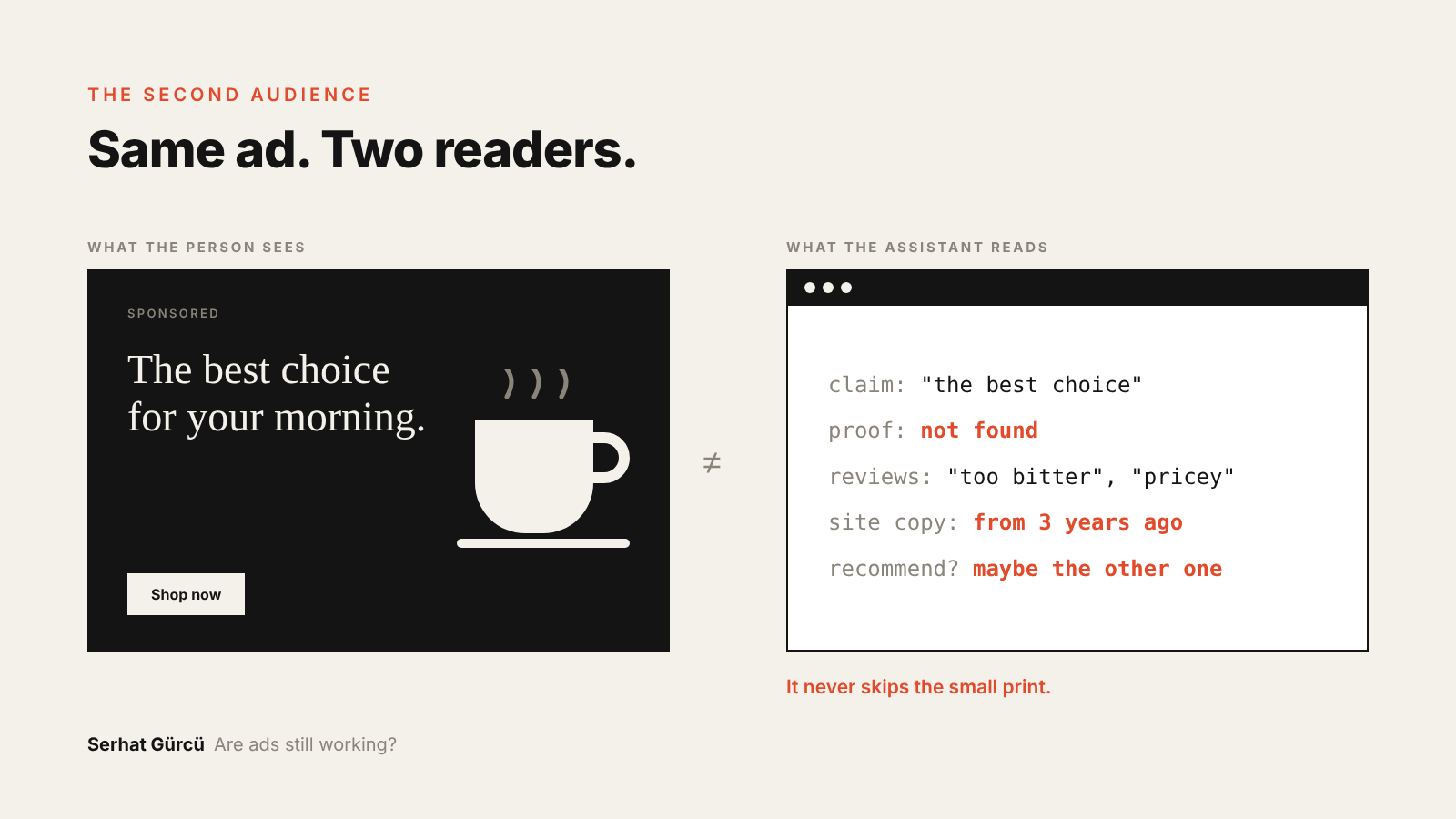
The second one reads it as a claim. "The best coffee in town." Source: none. Proof: zero.
So when someone asks an AI for the best coffee near them, the second audience decides who gets named. A claim with no proof doesn't make the cut.
That's the cover. Same ad, two readers.
Advertising has always had one job. Get chosen.
Simple job. Hard to do.
It doesn't matter how beautiful the film is. It doesn't matter how smart the targeting is. It doesn't matter how big the budget is.
If nobody chooses you at the moment of decision, what did you pay for?
Meaning, "are our ads working?" is the wrong first question. The better one is this: where does the decision happen now, and who else is in the room?
Most brands I see are choosing between three paths.
- Keep spending the way they always have, and hope the numbers hold.
- Cut brand budgets and move everything into performance, because at least that is measurable.
- Learn to speak to two audiences at once. The person, and the AI that person asks before they buy.
The teams I respect are moving toward option 3. Quietly, and a little nervously.
Why?
Because the person scrolling past your ad is no longer the only one deciding. In this letter, I'll show you what is changing, why most brands are reading it wrong, and a simple exercise you can run with your team this week.
I. Ads are working. The audience changed.
Three numbers tell the story.
Adobe surveyed more than 5,000 US consumers this summer. 42% have already used an AI assistant for shopping.
IAB asked more than 200 US brand and agency investment leaders about the year ahead. 86% are changing, or expect to change, how they measure marketing within 12 months because of conversational AI and agents.
And a Visa and Harris Poll survey found that only 23% of Americans trust generative AI to handle payments for them.
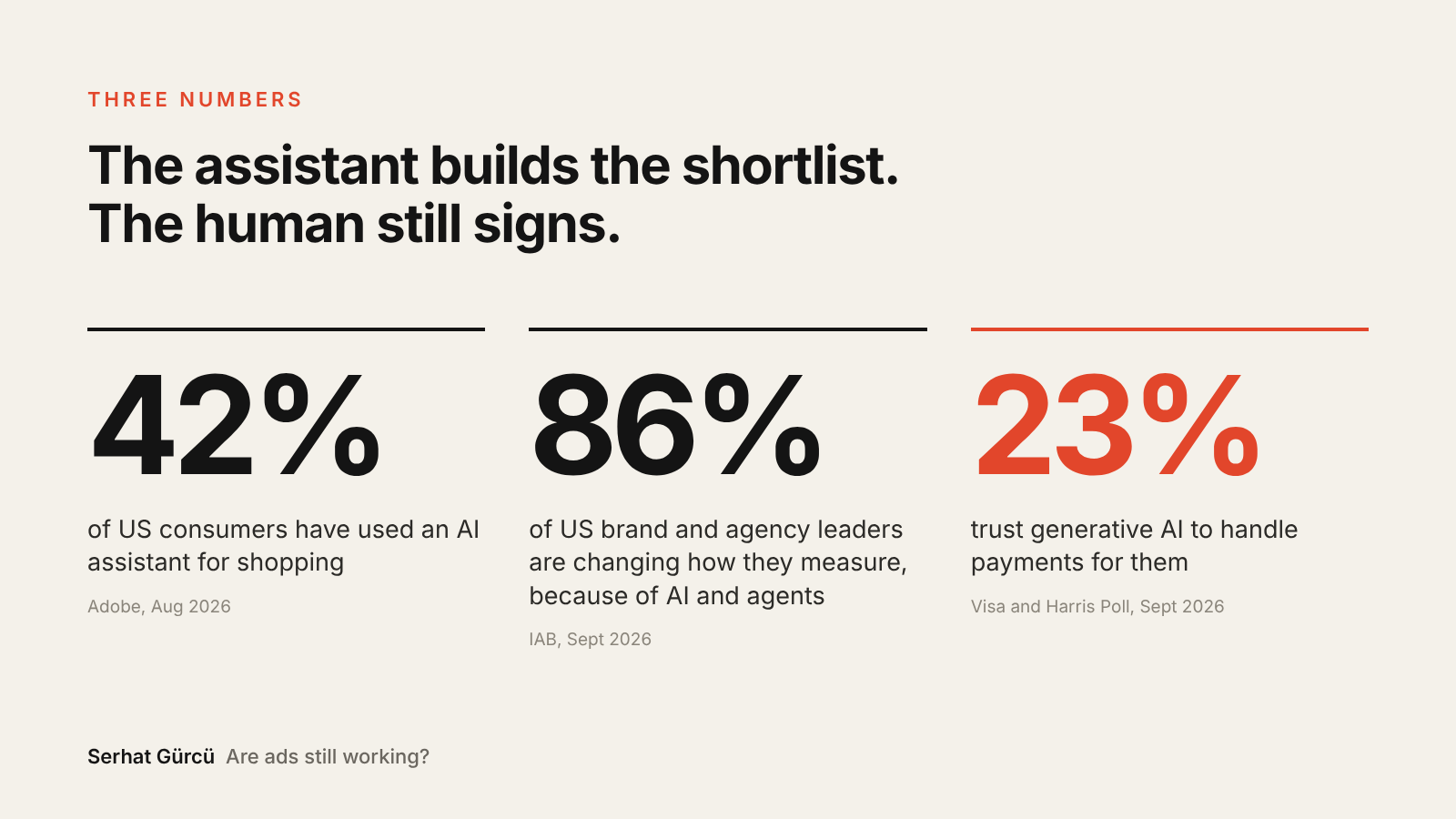
Read those together.
The assistant builds the shortlist. The human still signs.
So ads still work. They just have to work twice. Once on the person, and once on the machine that person trusts to do the homework.
I've watched this shift from three seats. Around twenty years on the agency side serving major brands. Building marketing AI for enterprise brands. And a creative studio in London where human creative directors and AI agents work on the same brief. Different seats, same pattern.
Your next customer may meet your brand through an answer before they ever see your ad.
II. Meet the second audience
Your advertising used to have one audience. A person, on a sofa or on a train, half paying attention.
Now there is a second one. The assistant that person opens when it is time to decide. It has read your website, your reviews, the articles about you, and probably your competitor's best campaign. It never gets tired, and it never skips the small print.
I call this the Second Audience.
Most teams think it is a technology problem. It isn't. It is a creative brief that only names one audience.
Here is what I keep hearing from marketing teams:
"We spent a year building the campaign. We never checked what AI says about us."
"The assistant describes us the way we talked three years ago."
"Our product pages are perfect for people. Apparently machines find them hard to read."
And here is where most brands stand.
Almost nobody is briefing for the Second Audience. Some are testing how AI assistants describe them. Most are still asking whether their ads work, and measuring it the old way.
That is your competition. The bar is low, which is good news.
Will ads die? No. But they will have to impress a reader that has read everything.
III. If you were my client, here's what we'd do this week
No new tools. No big budget. One afternoon with your team.
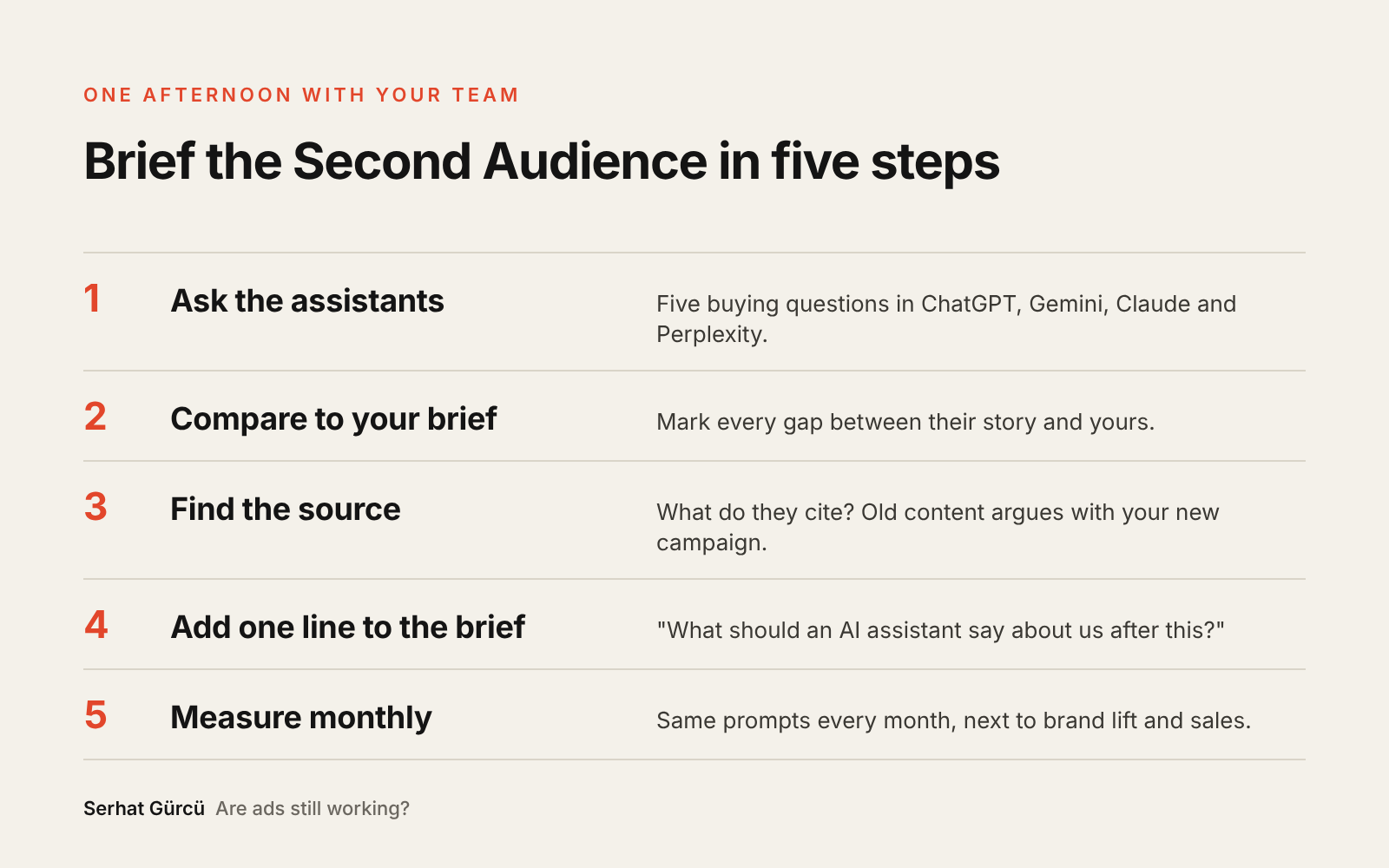
Step 1. Ask the assistants. Open ChatGPT, Gemini, Claude and Perplexity. Ask the questions your customer would ask right before buying. Copy these:
I need [your category] for [a real customer situation]. What should I buy, and why?
What is the difference between [your brand] and [your main competitor]?
Is [your brand] worth the price? What do people complain about?
Which [your category] brand would you recommend for [your core audience]?
What is [your brand] known for?
Screenshot every answer.
Step 2. Put the answers next to your brief. Does the story the assistant tells match the story your campaign tells? Mark every gap in red. (There will be red. That is the point.)
Step 3. Find where the story comes from. Look at what the assistants cite. Your site, a review, an old article, a forum thread? That is the material the Second Audience studies. If it is outdated, your best campaign is arguing with your own past.
Step 4. Add one line to every brief. Next to "What should people feel?", write a second question: "What should an AI assistant say about us after this campaign?" If the team can't answer it, the brief isn't finished.
Step 5. Change one measurement. Run the same five prompts every month. Track how the answers change, next to your brand lift and sales numbers. It is not perfect science. Neither was the focus group.
This feels like a technical task. It isn't. It is the oldest job in advertising: making sure the right story gets told when you are not in the room.
IV. We've been here before
When I started YW in 2015, the industry said data would kill creativity.
But I saw something else. Data didn't replace the idea. It told us where the idea had to land.
Then it happened. The YW team brought creative and media together around data, and went on to win more than 100 awards. The ideas got better because they knew who they were talking to.
Ten years later, I'm seeing the same lesson from a different seat. At Adin, we have analyzed more than 300,000 ads. The ones that win are rarely the loudest. They are the ones built for where the decision actually happens.
The same conversation is back with a new name. They say AI will kill advertising. I see a second audience that brands haven't briefed yet.
The brands that write for both will be the ones the assistants recommend.
So, are your ads working?
Ask the assistant. Then ask your team.
Hope this was useful.
Serhat
Quick answers
Are ads still working in the age of AI assistants?
Yes, but they now have to work twice: on the person, and on the AI assistant that person asks before buying.
What is the Second Audience?
The AI assistant a customer opens at the moment of decision. It reads your site, reviews and press, and builds the shortlist.
How can a brand check what AI says about it?
Ask ChatGPT, Gemini, Claude and Perplexity five buying questions, compare the answers to your brief, and repeat monthly.
Sources: Adobe AI Traffic Trends, Aug 2026 · IAB 2026 Outlook, Sept 2026 · Visa and Harris Poll, Sept 2026